PDF · 9 pages
Instructor guide
The Cornerstones model, the “It’s OK to” checklist, and the five printable lesson plans in one guide.
IDEA Cornerstones® · Free for every driving instructor
Five practical lessons to help new drivers prepare for the situations they’ll face on their own.
We developed IDEA Cornerstones with Because Your Life Counts (BYLC), a road safety charity. The programme builds conversations about the risks of the first few years of driving into ordinary lessons. Learners can ask questions, try unfamiliar journeys at their own pace and build confidence in their decisions.
The aim is to reduce serious crashes and deaths on the road by helping learners practise the situations they will meet after passing.
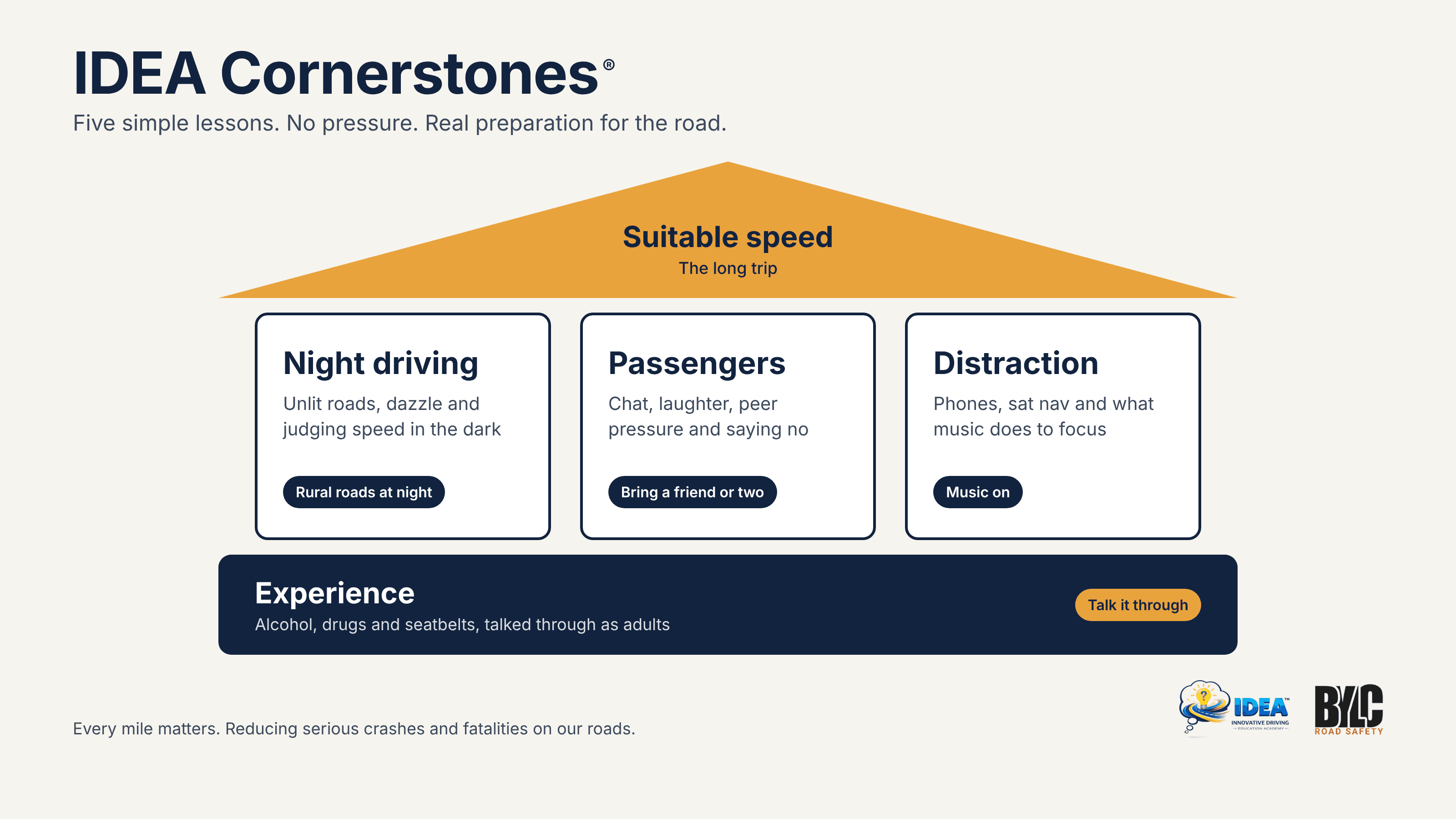
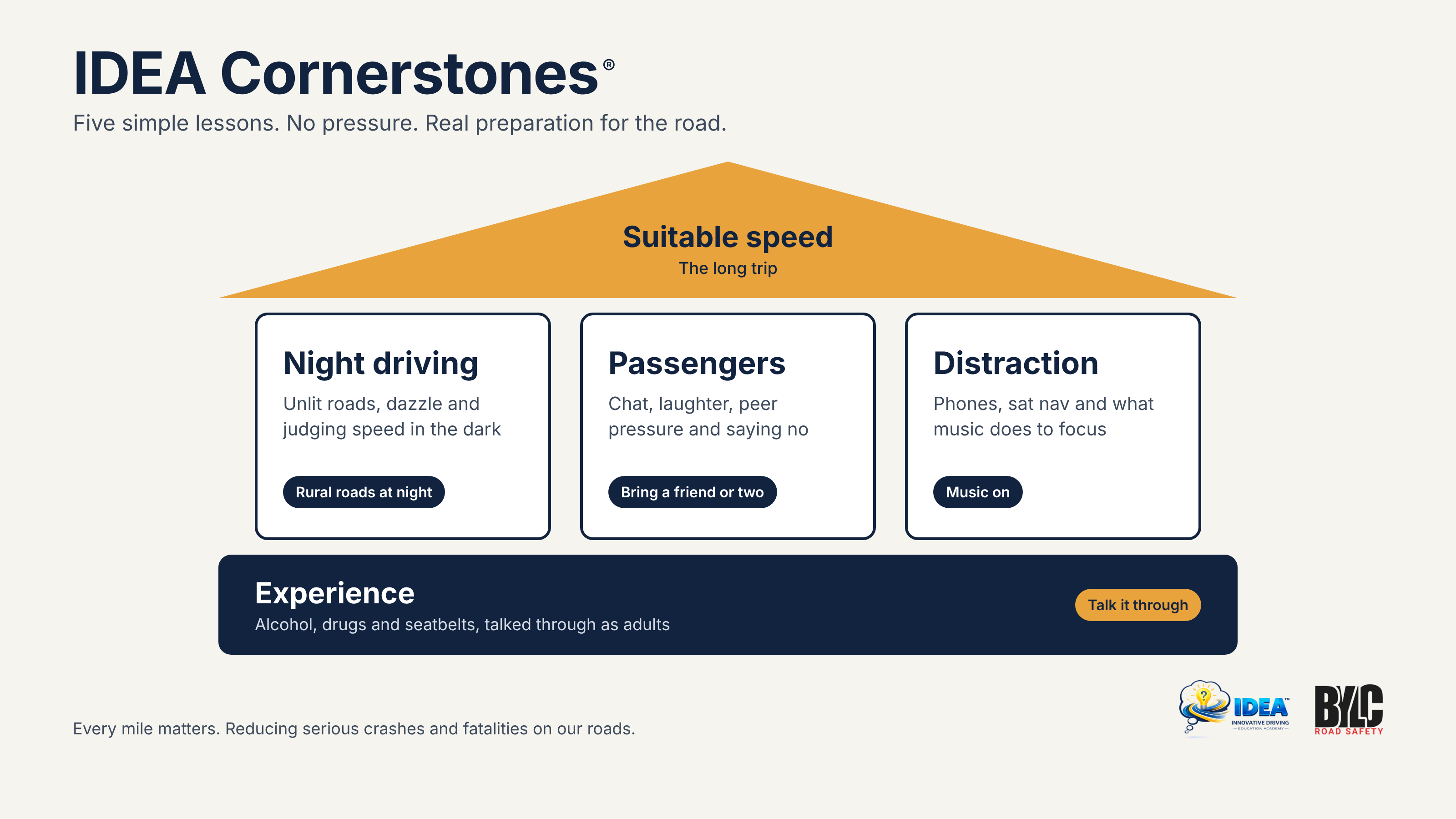
Experience is the foundation. Night driving, passengers and distraction are the three pillars. Suitable speed is the roof because choosing the right speed depends on everything underneath it.
Build these flexible activities into normal lessons. Adapt each one to the learner, their stage of training, the season and the roads they’re likely to use. For example, a night drive may be easier to arrange in winter. Choose a lesson to see its aim, steps and prompts.
Open conversations about alcohol, drugs and seatbelts, with practice on different roads.
Read lessonPractise driving in the dark on roads the learner is likely to use after passing.
Read lessonExperience driving with friends and practise speaking up when something feels unsafe.
Read lessonExplore how music can affect concentration, and choose what helps the learner stay focused.
Read lessonPlan a longer journey with vehicle checks, rest breaks and a speed that suits the conditions.
Read lessonFor schools, colleges and youth groups
A free, ready-made talk for BYLC volunteers or driving instructors to deliver. It covers the five Cornerstones, the ‘It’s OK to…’ checklist and ways to say no, with questions for the class.
For families
Think of it like a school parents’ evening. With the learner’s agreement, you can sit in on a lesson, see how they drive and ask questions. You can come even if you don’t have a car or time for private practice. Offer a lift home at any hour, no questions asked. If a journey feels unsafe, they’ll know they can call you.
More for parents and carersFor instructors
Build these flexible activities into normal lessons. Adapt each one to the learner, their stage of training, the season and the roads they’re likely to use. For example, a night drive may be easier to arrange in winter.
Help the learner talk through decisions about alcohol, drugs and seatbelts, and build experience on a range of roads.
In early lessons, use five minutes at the start or end of the drive.
How would you get home if you’d had a drink? What would you say if a friend didn’t put their seatbelt on?
Today we talked about alcohol, drugs and seatbelts. Ask them what they’d do if they needed a lift home.
Give the learner experience of roads they expect to use regularly, after dark and before their test.
Midway through the course, once the learner is ready. Choose a time when it will be dark on the planned route.
What felt different in the dark? Could you stop within the distance you could see was clear?
Tonight we drove the rural roads in the dark. Ask them what surprised them.
Help the learner experience a journey with friends, stay focused and find words they can use to set boundaries.
Midway through the course or later, once the learner is confident in traffic and agrees to invite friends.
When was it hardest to concentrate? How would you ask a friend to quieten down without feeling awkward?
Today they drove with friends in the car. Ask them how it felt.
Help the learner notice how music can affect what they hear, where they look and the speed they choose.
Once the learner is settled on a familiar route. It can be paired with practice using a sat nav.
Did the music change what you noticed? What would you choose to play when you’re driving alone?
Today we explored how music can affect concentration. Ask them what they noticed.
Help the learner plan and drive the kind of longer journey they expect to make after passing, including a motorway where appropriate.
Late in the course, when the learner is ready. A double lesson gives time for planning, driving and a break.
When would you stop for a break? What would you check before a long drive on your own?
Today we planned a longer trip, checked the car and took a rest break. Ask them how they’d plan their first long drive.
Invite a parent or carer to the lesson
With the learner’s agreement, invite a parent, carer or someone they trust to sit in the back, watch a normal lesson and ask questions. Think of it as a parents’ evening in the car.
For learners
Passing your test is the start. These five lessons give you a chance to practise unfamiliar journeys with your instructor before driving on your own.
Tap the statements you agree with. Use them to start a conversation with your instructor.
0 of 8 selected
1. Talk it through
Talk openly about alcohol, drugs and seatbelts, and try a range of roads.
2. Rural roads at night
Drive the roads you’re likely to use after passing and see how they feel after dark.
3. Bring a friend or two
Find out how it feels to drive with friends in the car and practise asking for quiet.
4. Music on
Bring your playlist and consider what helps you stay focused while you drive.
5. The long trip
Plan and drive a longer journey, including a motorway where you’re ready and allowed, with a rest break along the way.
Ask your instructor about the five lessons
For families
Think of it like a school parents’ evening. With the learner’s agreement, you can sit in on a lesson, see how they drive and ask questions. You can come even if you don’t have a car or time for private practice. Offer a lift home at any hour, no questions asked. If a journey feels unsafe, they’ll know they can call you.
Some new drivers first encounter rural roads at night, a car full of friends or a long motorway journey after they pass. The lessons give them a chance to prepare for those situations with support. You can help by sitting in on a lesson if the learner agrees, and by talking about what they’re learning at home.
Tonight we drove the rural roads in the dark. Ask them what surprised them.
Today they drove with friends in the car. Ask them how it felt.
Ask the learner’s instructor about sitting in
For schools, colleges and youth groups
A free, ready-made talk for BYLC volunteers or driving instructors to deliver. It covers the five Cornerstones, the ‘It’s OK to…’ checklist and ways to say no, with questions for the class.
PDF · 13 slides
A ready-made talk for schools, colleges and youth groups, for BYLC or driving instructors to deliver.
The free toolkit
Open a resource to read it here or save a copy to print and share.
When using the lesson plans, follow the lesson safety guidance.
PDF · 9 pages
The Cornerstones model, the “It’s OK to” checklist, and the five printable lesson plans in one guide.
PDF · 6 A4 pages
A printable page for each of the five lessons, plus a plan for inviting a parent to sit in.
PDF · Double-sided A4
Print it or send it. Learners on the front, parents and carers on the back.
PDF · 13 slides
A ready-made talk for schools, colleges and youth groups, for BYLC or driving instructors to deliver.
PNG · High resolution
The model diagram for presentations, social posts and your own website.
Read the guide
Start with three pages of overview, then use the plan for each lesson.
Share the leaflet
Give it to learners, parents and carers early in the course.
Weave in the lessons
Fit the activities into normal lessons. With the learner’s agreement, invite a parent, carer or someone they trust to sit in.
Yes. Every resource here is free for driving instructors to use.
The activities fit into the lessons you already deliver. Printable plans are included if you’d like to use them.
Learners and instructors decide together which situations to practise and when the learner is ready for them.